What is AI doing to us?: Cognitive Displacement Theory of Human Progress
A reflective essay exploring how major human tools—from fire and writing to computers and AI—don’t eliminate human effort but relocate it to higher levels of thinking. It introduces the idea of “Cognitive Displacement Theory,” arguing that AI continues a long historical pattern where technology externalizes lower-order tasks, pushing humans toward new frontiers like judgment, synthesis, creativity, and meaning-making. The piece ultimately suggests that the real risk of AI is not cognitive loss, but stagnation in how we choose to use it.
A friend asked a question that inspired a conversation, which ultimately led to what you’re reading right now:
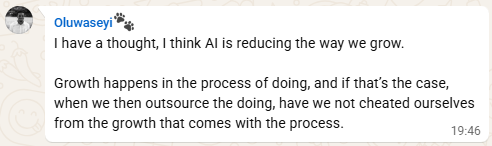
His premise was also seconded by another friend, who highlighted a danger in the use of AI, which we might talk about briefly in this piece.
In response to the above thought, he said:
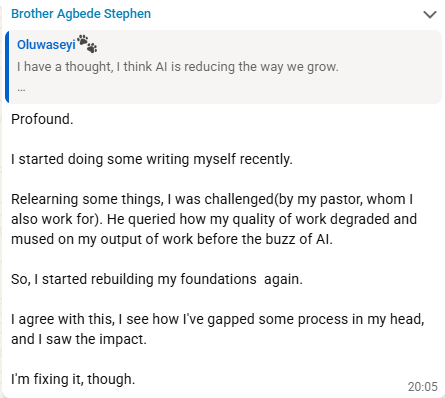
We decided to have a call to share our thoughts and determine what consensus we might arrive at.
This piece is a build-up of my thoughts around the question my friend asked.
TL: DR
My premise is that AI, as with every other tool known to man, will have its effect on man; however, we must realize that tools are what they are, tools. Humans are the ones who determine the extent to which tools will influence their lives.
I decided to think back and explore a few of the many tools we have discovered or invented as a species, and how it has changed how we think.
And just to state this out clearly, this article was worked on with the use of ChatGPT (a tool), layered on the foundation of several other tools (internet, computers, woodwork, etc.) that have changed the way we think, and also approach life.
Alright! Let’s get into it.
The fear surrounding AI is not new.
Civilization has repeatedly confronted technologies that appeared to “cheat” human effort.
- Fire reduced the labor of survival.
- Writing reduced the labor of memory.
- Machines reduced the labor of physical work.
- Computers reduced the labor of calculation.
- Now, AI reduces portions of cognitive labor.
At every stage, humanity asked the same underlying question:
“If we no longer struggle through the process, do we lose the growth that struggle produces?”
Another version of the same age long question
This is a valid ask as a species, and whenever we are at the brink of something life-altering, this question will come up again, in this same way, or maybe in another format.
This concern assumes that growth is tied to preserving existing forms of labor. We feel a need to stick with the status quo because we subtly believe that this level of excellence, efficiency and capability is tied to the process of struggle associated with the consequent results.
History suggests otherwise.
Human progress does not occur because humans continue doing the same things harder. It occurs because humans continuously displace effort from one layer of activity to another.
This is Cognitive Displacement Theory:
Human advancement happens when technology externalizes a lower-order human task, forcing civilization to relocate growth into higher-order forms of thinking, coordination, and creation.
The pattern goes way back.
Let’s explore a few examples. I used these examples in the conversation with my friends, and I am poised to stick with it because I beleive they are quite relatable.
Fire: The Displacement of Survival Labor
Before fire, much of human existence was trapped inside biological maintenance:
- chewing
- digesting
- surviving darkness
- avoiding predators
Fire outsourced these burdens.
This likely reduced certain primitive capabilities humans once relied on. Yet it created surplus energy and time. Around fire emerged:
- storytelling
- social bonding
- planning
- symbolic communication
The effort did not disappear; it was redirected, or in other words, repurposed.
Fire displaced survival efforts into cognitive and social development.
Language and Writing: The Displacement of Memory
Language allowed humans to store knowledge outside individual experience. Writing intensified this transformation by preserving thought across generations.
Critics feared this would weaken memory and produce shallow understanding. Even Socrates argued that writing could create the illusion of wisdom without true comprehension.
And in some sense, he was right:
- Humans memorized less
- Oral mastery declined
But civilization gained:
- philosophy
- mathematics
- science
- law
- historical continuity
Memory was displaced into external systems, allowing cognition to evolve toward abstraction and analysis.
Again, effort moved upward.
The Industrial Revolution: The Displacement of Muscle
Machines replaced repetitive physical labor.
This created fear that mechanization would weaken human capability and dignity.
Instead, humanity reorganized itself around:
- engineering
- management
- logistics
- systems coordination
Physical effort declined as the center of human value. Cognitive specialization expanded.
The focus shifted from physically intensive work to more mental and cognitive requirements.
This is the reason some of us have jobs today.
The growth was not eliminated. It steered us in another direction.
Computing: The Displacement of Calculation
Computers removed the need for humans to perform large-scale calculations manually.
The internet removed the friction of information access.
This reduced dependence on:
- memorization
- arithmetic repetition
- manual retrieval
But it increased demand for:
- interpretation
- navigation
- synthesis
- critical filtering
The valuable human skill shifted from storing information to understanding relationships between information.
AI: The Displacement of First-Pass Cognition
AI represents the next layer of displacement.
Unlike previous tools, AI does not merely automate physical or memory-based tasks. It begins automating:
- drafting
- ideation
- pattern generation
- organizational thinking
- first-pass reasoning
This creates discomfort because it touches the visible process of thinking itself.
The concern is understandable:
- If humans outsource thinking, will humans lose the ability to think?
But historically, displacement has never eliminated growth. It has transformed where growth happens.
The central mistake is assuming that growth only exists in the original layer of effort.
AI may reduce growth in:
- repetition
- memorization
- procedural drafting
But it may increase growth in:
- judgment
- systems thinking
- taste
- direction-setting
- interdisciplinary synthesis
- meaning construction
The question is not whether growth disappears.
The question is whether humans intentionally step into the new layer of required growth.
The Real Risk of AI
The danger of AI is not automation itself.
The danger is stagnation.
Every major technological leap creates two groups:
- people who use the technology to elevate themselves into higher-order capability
- people who use the technology only to escape effort entirely
Technology amplifies intent.
A calculator can free someone to study advanced mathematics, or prevent them from learning arithmetic fundamentals.
AI follows the same pattern.
Used passively, it can produce cognitive dependency.
Used actively, it can accelerate conceptual depth and creative execution.
Conclusion
Human history is not the story of a perpetual struggle.
It is the story of transforming struggle.
Every major invention has removed a layer of labor while creating a new frontier of human development.
AI is not ending growth.
It is relocating it.
The future question is not:
“Will humans still struggle?”
Humans always will.
The real question is:
“What kinds of struggle remain uniquely human after intelligence itself becomes partially externalized?”